
Quick Answer
Aging can reduce Heart and Stamina, with further skill-point losses at year-end: your trainer emails "You're getting old" and from then on you lose skill points at the end of every year. There's no fixed birthday cutoff to plan around — the October 22, 2026 hotfix moved aging later without naming a starting age, so ages you read from earlier runs don't apply to yours. When the warning lands, weigh further training against retirement.
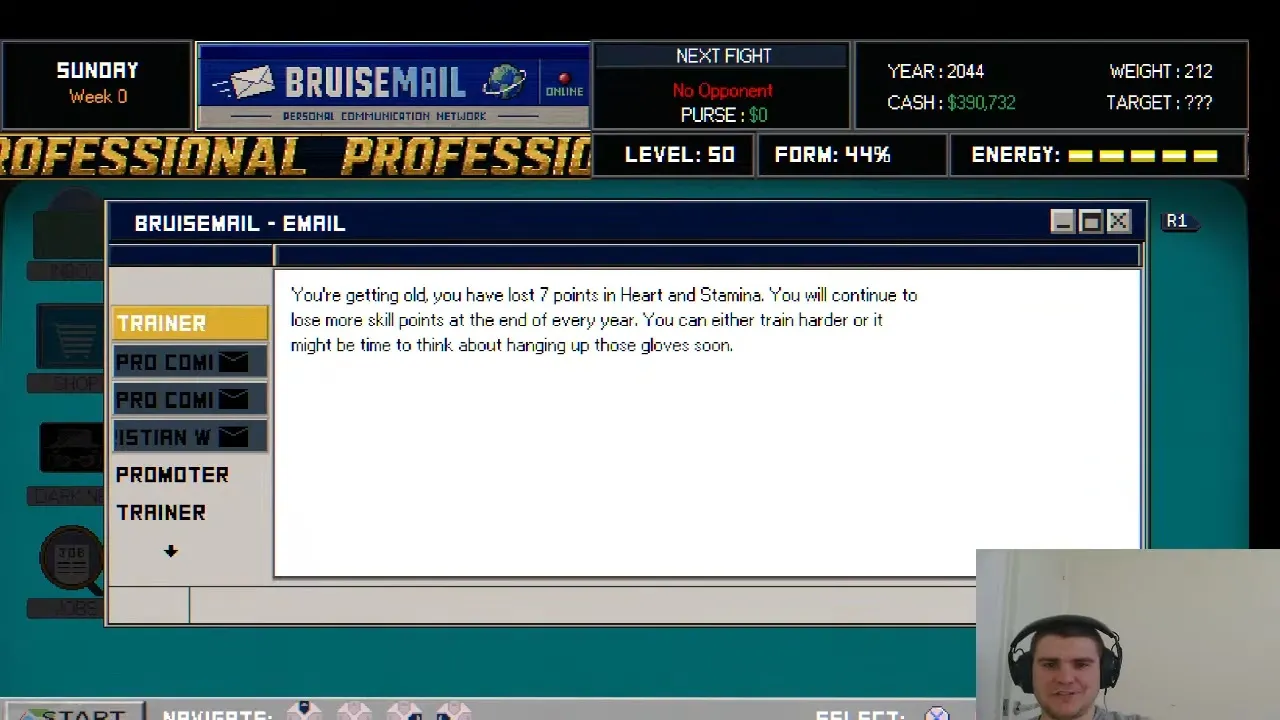
The aging warning arrives as a BruiseMail from your Trainer at the start of a new year (Sunday, Week 0): 7 points lost in Heart and Stamina, more skill points lost at the end of every year.
Shown at 66:56 in Drop Bear’s video.How Does Aging Affect Your Boxer's Stats?
Aging takes points out of Heart and Stamina, then keeps taking skill points at the end of each year. Your boxer gets older as the weeks of the career pass, and the years stack on top of the damage you've soaked up in hard fights. As one guide video puts it: "your biggest long-term opponent isn't the division champion, it's the clock."
Here's what the warning said in one career, word for word on screen: "You're getting old, you have lost 7 points in Heart and Stamina. You will continue to lose more skill points at the end of every year." That boxer was 35 when it arrived. The seven points are that one career's number, not a fixed deduction every fighter takes — in another career the same warning read "You lost three points in stamina and heart," and that player answered it by spending banked skill points: "we have so many banked skill points that… just put them back."
| Item | Aging Warning |
|---|---|
| Named stats | Heart and Stamina |
| Reported loss | Seven points |
| Further losses | End of each year |
| Suggested responses | Train harder or consider retirement |
The part that matters is the continuing loss. This isn't one bad day for your numbers — it repeats every year. When you plan the rest of the career, count those yearly losses against the points you expect to gain from training.
When Does Decline Start in Bruisers 2D Boxing?
Decline starts when your trainer's "You're getting old" email arrives — there's no published age. The October 22, 2026 hotfix moved aging later, and its change description only says aging now happens "a bit later."
That's why ages you see on forums don't transfer. Players posted about points dropping at 25 and about heavy aging penalties at 33, but the 33-year-old career was played entirely before the patch, and the 25 report doesn't say which version it was. A career that started on the old timing tells you how decline used to feel, not when it hits you now. For reference, one new boxer started his career at 17, and one post-patch boxer got the warning at 35.
So trust the email on your own fighter over a borrowed number. It tells you a loss has already happened to your boxer and that more are coming. Once you see it, build decline into your next decision — don't assume another player's age buys you extra years.
The hotfix only shifts the timing. Aging is still more than cosmetic: your boxer still gets older, and a career of hard fights still carries accumulated damage. Keep both in mind when you decide how much more boxing you want out of the same fighter. One streamer summed up the late stretch: "Can't beat Father Time, unfortunately, guys."
If you're comparing an older run with yours, check the relevant Bruisers 2D Boxing update before treating their experience as a timetable.
How Should You Handle Aging and Accumulated Damage?
Weigh training harder against retiring, and treat fight damage as a career-long cost from your first bout. The warning itself gives you those two options: train harder, or think about hanging up the gloves.
- Read the loss before planning more training. Split the points already gone from the warning about future yearly losses. The first is what happened; the second is why next year needs a plan.
- Count the cost of another hard fight. Damage builds up across a career. Winning doesn't erase the punishment you took to get the win.
- Skip wild exchanges just to chase a quick knockout. The payoff is an early finish; the price is extra wear you carry into every later year.
- Deal with ignored injuries before the next bout. As one guide video warns, "that injury you ignored because you had an important fight the following week doesn't disappear" — it can turn into a serious limitation later. Think past the next result when you manage your fighter.
Age and accumulated damage both matter. Not every late-career problem is a birthday penalty — check your boxer's injuries and health too.
Next, go back to your training options with the aging loss in mind, and decide whether this fighter is still worth investing in before you commit to another stretch of the career.
FAQ
Heart and Stamina are the stats named in the aging warning. In one career it took seven points and said more skill points would go at the end of each year.
There's no published age — the October 22, 2026 hotfix only says aging now happens later. One post-patch boxer got the warning at 35; don't treat any single player's age as a universal deadline.
Yes. The warning says you keep losing skill points at the end of every year. The seven-point example is one career, not a fixed yearly deduction for every fighter.
Weigh training harder against retiring, as the warning suggests. Factor in accumulated damage and ignored injuries along with the points already lost.